ZK/SEC Research notes from zkSecurity
All posts
Proof is in the Pudding · Part 2 of 10

Archetype x zkSecurity (Whiteboard Session) - Proof is in the Pudding: zkTLS

Proof is in the Pudding: zkTLS

Proof is in the Pudding is a IRL series of whiteboard sessions hosted by Archetype and zkSecurity.

For Session 02, we cover zkTLS (also called zkOracles, HTTPz, or MPC-TLS). This includes public approaches like public oracles (chainlink), TEE approaches like TownCrier, TLS Notary and Deco style approaches that mix using MPC protocols or pure proxies.
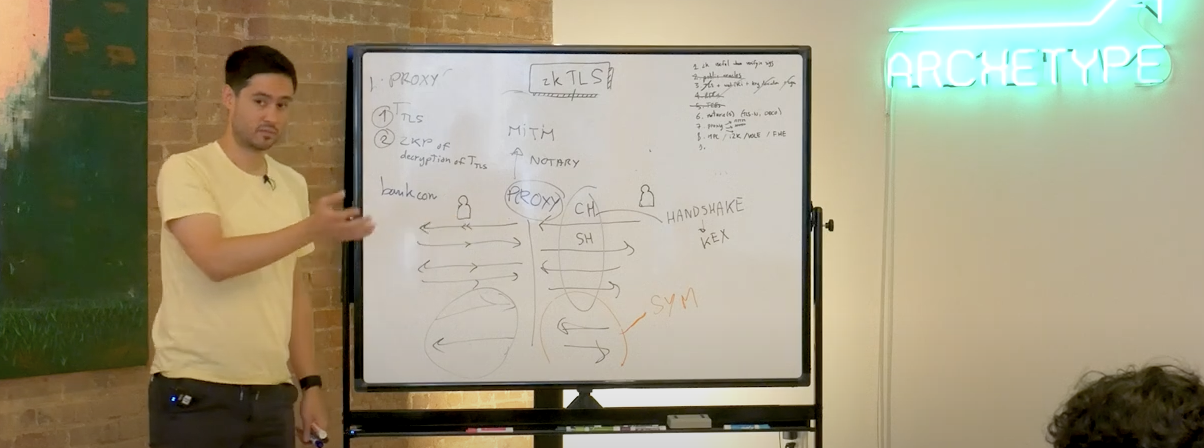
recorded session of proof is in the pudding

Watch it on Archetype's channel!

Keep reading
Recommended

Archetype x zkSecurity - Proof is in the Pudding: Privacy in Payment Networks

In Session 08 of "Proof is in the Pudding," we explore how different networks have approached privacy over the years. From E-Cash and Monero to MobileCoin and Zether, we break down blind signatures, Pedersen commitments, stealth addresses, ring signatures, and more. This session provides a comprehensive tour of the techniques used to break linkability, hide addresses, and obscure transaction data in the name of privacy and safety.

ZK/SEC · January 16, 2026

Projects That Shaped Modern zkVMs, Part 1

Curious about how zero-knowledge virtual machines (zkVMs) make computing more secure without the hassle? We delve into the fascinating world of zkVMs, where you can program in high-level languages like Rust or C and let cryptography handle the complexity. We'll explore the evolution of these innovative systems through projects like Cairo and RISC Zero, while touching on the unique benefits and technical insights each brings. Plus, learn about groundbreaking techniques for optimizing zkVMs with projects like Jolt, and discover a range of other influential zkVM initiatives. Get ready for an enlightening journey into secure computation!

Marco Besier, David Wong · February 26, 2025

zkVM Security: What Could Go Wrong?

Ever wondered how zkVMs simplify the use of zero-knowledge proofs in coding? We dive into how they let developers focus more on application logic by abstracting complex cryptographic aspects, using familiar languages like Rust or C++. But hold on, it's not all smooth sailing. Despite these benefits, a single bug anywhere in the complex system of compilers, proof systems, or verification can lead to serious security issues. In the post, we break down the zkVM workflow, explore common vulnerabilities at each phase, and highlight the importance of understanding these layers to build more secure, zk-powered applications. Curious about how this all plays out? Let’s unravel it together!

Suneal Gong · November 21, 2024
More to explore

Uncovering the Phantom Challenge Soundness Bug in Solana's ZK ElGamal Proof Program

In June 2025, we uncovered a serious soundness issue in Solana's ZK ElGamal Proof Program that could let attackers manipulate confidential token transfers undetected. We worked with the Anza team to quickly address the flaw by pausing and disabling vulnerable components. This post dives into the root cause, which was a subtle mistake in handling prover-generated challenges within sigma OR proofs, revealing broader lessons in zero-knowledge protocol security. If you're interested in cryptographic protocol design, this could provide valuable insights.

Suneal Gong · June 26, 2025

Circle STARKs: Part II, Circles

In this blog post, we dive into the fascinating world of Circle STARKs, exploring the algebra of complex numbers and how they can be extended to any field. We revisit the concept of the unit circle and its unique group structure, which allows for cool operations like squaring and doubling angles. You'll discover how these ideas apply to finite fields, creating intriguing structures like the twin-coset and standard position coset. The post leads us to understand vanishing polynomials, crucial in STARKs, and sets the stage for exploring the circle FFT in upcoming discussions. Perfect for anyone curious about cutting-edge cryptographic techniques!

Varun Thakore, Mathias Hall-Andersen · February 21, 2025

Proximity Gaps: What Happened and How Does It Affect our SNARKs

A series of recent papers just disproved the proximity gaps conjecture, which has everyone wondering if hash-based SNARKs are in trouble. We break down what actually happened using some helpful visuals. Think of it as understanding which parameter choices are safe versus which ones are now confirmed to be risky. The post walks you through the different security zones (proven safe, conjectured safe, and definitely not safe), explains how these new results connect to other open math problems, and shows what it means for real-world SNARKs in terms of proof sizes and performance trade-offs.

Nicolas Mohnblatt · November 14, 2025