ZK/SEC Research notes from zkSecurity
All posts
educative · zk

zkHack x zkSecurity (Whiteboard Session) - What is Zero-Knowledge (like, actually)?

What is Zero-Knowledge (like, actually)?

zkSecurity is helping zkHack kick off a new season of zkHack whiteboard sessions!

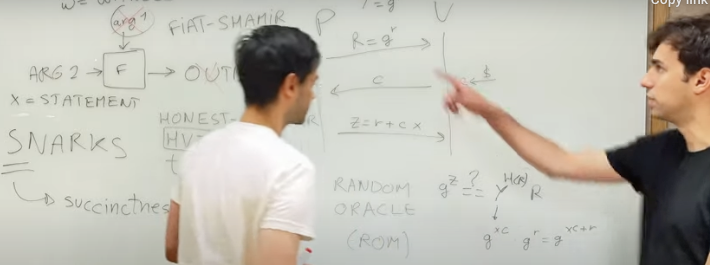
In this module, Nicolas Mohnblatt and David Wong from zkSecurity dig into the term “Zero Knowledge” and discuss what this property actually is, when it is being used (or not) and what characteristics some systems need in order to be considered truly ZK. They then highlight the different types of ZK (perfect, statistical, and computational), discuss the distinction between dishonest and honest verifiers, and the preference for adaptive models over non-adaptive ones. Additionally, they explore methods for generating hiding commitments from techniques such as KZG, Pedersen, and hashes, and conclude with an overview of the zero-knowledge analysis of PLONK.

watch it on youtube or on the zkhack.dev page

What's in it? Check the timestamps:

00:00 – Introduction 01:03 – ZK, SNARKs, Proving… High-level overview 04:53 – Defining ZK and the concept of Simulator 08:41 – A concrete example of a Simulator with the Schnorr Identity Protocol 14:06 – Honest vs. dishonest Verifier 19:28 – Non-interactive to interactive protocol with Fiat-Shamir 24:50 – The 3 flavors of ZK 29:52 – Application to the PLONK protocol 46:37 – Managing KZG and its trusted setup 50:00 – The ZK flavor of PLONK 57:02 – Summary

Keep reading
Recommended

zkBank: you think you have what it takes to work at zkSecurity?

Join us as we dive into the world of ZK through an exciting challenge called zkBank! Whether you're a bug-hunting enthusiast or just curious about zero-knowledge projects, this is your chance to test your skills and learn across various areas. Think you can crack it? Check out the details and see if you have what it takes.

ZK/SEC · February 27, 2024

zkBitcoin: Use Zero-Knowledge Applications (zkapps) on Bitcoin

We're excited to introduce zkBitcoin, a new tool that lets you create zero-knowledge applications on Bitcoin using a minimal layer 2 protocol. This innovation opens up a world of complex, privacy-focused apps by enhancing Bitcoin's scripting capabilities. We're currently on testnet, so you can jump in and explore the possibilities. Check out our whitepaper or watch some videos for a deeper dive. It's an exciting time for Bitcoin development, and we can't wait to see what you'll build!

David Wong · January 31, 2024

Introducing bugs.zksecurity.xyz a knowledge base for ZK bugs

We're thrilled to introduce our new site, [bugs.zksecurity.xyz](https://bugs.zksecurity.xyz/), a hub for exploring past vulnerabilities in ZK circuits. Dive into our growing catalog of documented bugs and learn how we've reproduced some with comprehensive scripts. Discover evaluations of prominent security tools like Circomspect and Picus, and see where they shine or stumble. We're calling on the community to join us in expanding this invaluable resource, whether by adding bugs, reproducing them, or improving our platform. Let's collaborate to elevate ZK security together!

Stefanos Chaliasos · February 17, 2025
More to explore

FRIDA: Data-Availability Sampling from FRI

We've just dropped a blog post exploring the cool world of Ethereum's latest EIP-4844 upgrade and how it tackles the data-availability conundrum with Proto-Danksharding. Get ready to dive into the intricacies of making data more accessible (and less pricey) by using nifty concepts like blobs and polynomial evaluations. Plus, we dish on the role of FRI in data-availability sampling and how it can streamline things even more. Curious? Check out the details and see how this all shapes Ethereum's future!

Mathias Hall-Andersen · June 25, 2024

Optimizing Barrett Reduction: Tighter Bounds Eliminate Redundant Subtractions

In this blog post, we explore an optimization for Barrett reduction, a popular method for modular arithmetic. We discovered that the error bound can be tighter than traditionally thought, meaning you often only need a single subtraction instead of two. This tweak can speed up cryptographic operations like those in the RustCrypto library by 14% when applied to NIST curves, which is a game changer for both encryption and performance. Dive into the details to see how this simple change can lead to significant improvements in real-world applications!

Suneal Gong · May 01, 2025

Circle STARKs: Part III, Circle FFT

In this blog post, we explore how to efficiently implement polynomial operations using Circle FFT in the context of STARKs, drawing parallels with the Cooley-Tukey FFT. We discuss how the Circle FFT handles bivariate polynomials over the circle group, replacing traditional multiplicative subgroups with twin-cosets. You'll discover the nuanced process of decomposing and recomposing polynomials using projection and squaring maps, leading to efficient computations. We also address the gap between the polynomial degree space and the space spanned by Circle FFT. This is a fascinating dive into the heart of polynomial computations in cryptography.

Varun Thakore · August 04, 2025