ZK/SEC Research notes from zkSecurity
All posts
educative · MPC

zkSecurity x Bain Capital (Whiteboard Session): Unveiling the Power of Multi-Party Computation

We're excited to announce our participation in Bain Capital Crypto's Whiteboards series!

In the inaugural episode, David teams up with Guillermo Angeris, Bain Capital Crypto's Head of Research, to delve into the fascinating world of Multi-Party Computation (MPC).

Watch the full episode and explore the cutting-edge of multi-party computations.
mpc part 1

part 1: additively-shared secrets in arithmetic circuits.
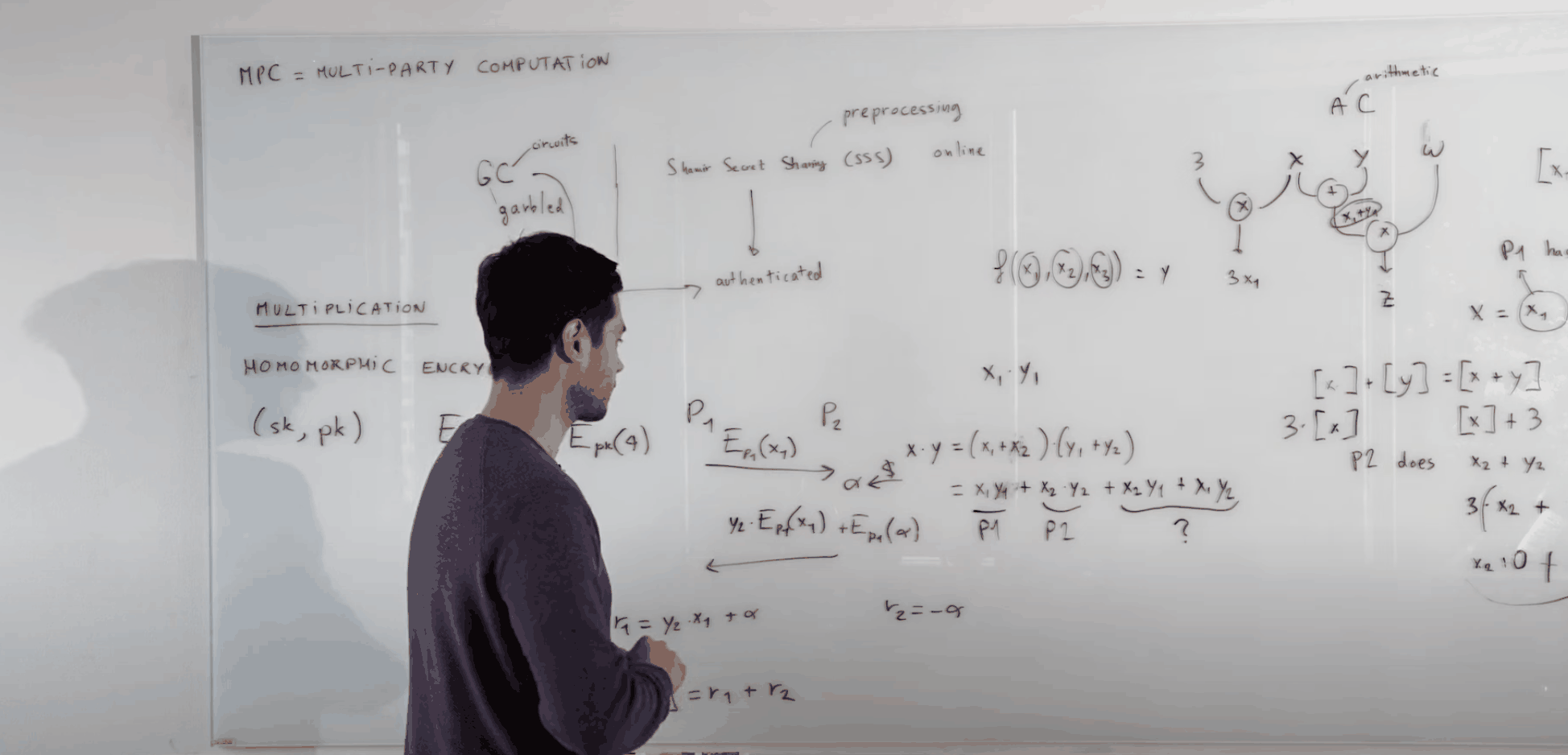
mpc part 2

part 2: Shamir Secret Sharing and multiplications.

Need auditors to look at your MPC stack? Get in touch with us: hello@zksecurity.xyz.

Keep reading
Recommended

A Gentle Introduction to the MPC-in-the-Head Transformation

In this blog post, we dive into the fascinating world of zero-knowledge proofs using the MPC-in-the-Head transformation, a clever method that constructs proof systems from any secure multiparty computation protocol. Originally proposed in 2007, this transformation uses a creative approach involving "imaginary parties" to prove knowledge without revealing it. We explain how this technique can be applied to develop post-quantum signature schemes, providing insights into its practical implications and efficiency. By exploring these concepts, readers will uncover a unique intersection of cryptography and computer science.

Giorgio Dell'Immagine · February 20, 2025

Watch what we have to say about ZK security in the Node Guardians season 2 episode 1

Catch our cofounder David Wong on the latest episode of Node Guardians, where he chats about ZK security with Sam. Dive into the intriguing world of blockchain auditing, uncover the role math plays, and explore how auditors tackle challenges and rate vulnerabilities. Plus, get insights into the usefulness of formal verification. It's a must-watch for anyone curious about the future of ZK and the nitty-gritty of blockchain security!

ZK/SEC · August 31, 2023

noname meets Ethereum: Integration with SnarkJS

We're excited to share that our programming language, noname, now supports R1CS, making it easier to write zero-knowledge (ZK) circuits and deploy them on Ethereum using SnarkJS. This update introduces an alternative to the common Circom language, with a simple and intuitive syntax inspired by Rust and Golang. In this post, we illustrate how to deploy a noname-based Sudoku circuit on Ethereum, demonstrating core benefits like proving a solution's correctness without revealing it. Dive in to explore how noname could potentially unify the fragmented zkSNARK ecosystem and simplify your circuit writing process!

Katat Choi · June 01, 2024
More to explore

zkBank: you think you have what it takes to work at zkSecurity?

Join us as we dive into the world of ZK through an exciting challenge called zkBank! Whether you're a bug-hunting enthusiast or just curious about zero-knowledge projects, this is your chance to test your skills and learn across various areas. Think you can crack it? Check out the details and see if you have what it takes.

ZK/SEC · February 27, 2024

Nine Years to Halve a Hash Function: RFC 9861 Is Out

After nearly a decade in the making, RFC 9861: KangarooTwelve and TurboSHAKE was officially published in October 2025, with zkSecurity among its editors. This post explains why these hash functions deserve to be far more widely used than they are today. Built on the same Keccak permutation as SHA-3 and SHAKE but with the round count halved, they do the same job at the same security level roughly twice as fast. We cover why halving the rounds is safe, what the RFC actually defines, the caveats around FIPS compliance and workload-dependent speedups, and why a standard like this took nine years to land.

David Wong · July 21, 2026

Threshold ECDSA: Building CGGMP from scratch

A step-by-step build of CGGMP, an n-of-n threshold ECDSA scheme where parties jointly produce a signature without ever reconstructing the private key. We start from the multiplicative-to-additive (MtA) protocol and a semi-honest version of the signing protocol, then harden it into a maliciously secure one by layering in zero-knowledge proofs at each step. Along the way we cover the auxiliary Ring-Pedersen and Paillier parameters and the proofs that make them safe to use.

Samuel Tang · July 27, 2026